Showing posts with label International. Show all posts

Wednesday, December 25, 2013

Certified enrolment specialist Richelle Baker, right, talks to Martha Medina, left, and her daughter Martha, both from Hialeah, Florida, at a Healthcare Insurance Marketplace office in Miami 20 December 2013 
Locations offering in-person help to complete the online enrolment process saw increased
 demand in the past few days

The US government has offered help to anyone who misses the 24 December deadline to enrol for the new health insurance - known as "Obamacare".

It said anyone who failed to finish their application through a dedicated website - HealthCare.gov - could still obtain a policy for the new year.

On Monday, the government extended the original deadline by a day amid high demand and technical issues.

HealthCare.gov has been plagued by glitches since its 1 October rollout.
The problems with President Barack Obama's signature bill have hit his popularity ratings hard.
The website was set up under a 2010 healthcare law that seeks to cover millions of Americans who do not have health insurance.
 'Don't worry'


Obamacare setbacks

  • Nov 27: Year's delay in online insurance enrolment for small businesses
  • Nov 26: Spanish-language sign-up tool is postponed until December
  • Nov 22: Enrolment deadline for individuals is pushed back a week in December
  • Nov 14: Obama announces insurers can keep customers on existing plans for another year
  • Oct 23: Deadline for individuals to avoid penalties is pushed back six weeks to March 2014
  • July: Businesses with over 50 workers given until 2015 to provide insurance or pay a penalty
"Sometimes despite your best efforts, you might have run into delays caused by heavy traffic to HealthCare.gov, maintenance periods, or other issues with our systems that prevented you from finishing the process on time," a message on the federal marketplace website said just hours before the Tuesday midnight (0500 GMT) deadline.

"If this happened to you, don't worry - we still may be able to help you get covered as soon as 1 January."

The website also provided helpline contact numbers and told applicants to "tell our customer service representative that you've been trying to enrol and explain why you couldn't finish by the deadline. 

"They can tell you what you can do to finish your enrolment and still get covered for 2014."
Two states have extended the deadline for coverage in the new year even further, to 27 December in Maryland and 31 December in Minnesota.

While the website has been upgraded over the course of the past two months, it has still experienced downtime in the past few weeks.

Americans may still enrol in private insurance plans through the website after Tuesday, but they will not be guaranteed coverage at the start of the new year.

A more important deadline for the Obama administration is 31 March, when enrolment in the programme ends for the year.

Those who do not have coverage through their employer, government-run health programmes or through the federal or state-run websites by then will have to pay a tax penalty.

Last week, President Obama said that more than one million people had enrolled in private insurance through federal and state-run websites since 1 October. 

Previously White House estimates called for 3.3 million Americans to enrol by the end of 2013, and about 7 million by the end of March 2014.

Source : BBC News

Saturday, December 21, 2013


Lockerbie montage
Services are being held at a number of venues to mark the events in the town of Lockerbie 25 years ago

Memorial services are to be held in the UK and the US to mark the 25th anniversary of the Lockerbie bombing in which 270 people were killed.

A wreath-laying and church service will be held in the south of Scotland town which was devastated when Pan Am flight 103 was blown from the skies in 1988.

A remembrance service is also being staged at Westminster Abbey in London.
In the US, a ceremony will take place at the memorial cairn in Arlington National Cemetery, near Washington DC.

The Lockerbie bombing remains the deadliest act of terrorism ever committed in the UK and until the attacks of 9/11 it was also responsible for the biggest single loss of American lives in such an attack.

The Boeing 747 was just over half an hour into its flight from London to New York when it exploded, seconds before 19:03 UK time, on 21 December 1988.
  
Memorial cairn
 
All 243 passengers and 16 crew died, and a further 11 people were killed in their homes when wreckage hit the ground in Lockerbie.

The majority of the passengers and crew on board the aircraft were US citizens. 

In the United States, a service of "hope and remembrance" is planned at the Hendricks Chapel of Syracuse University in New York state, which lost 35 students who had been studying at its London campus. The service will be followed by a procession to its Wall of Remembrance.

A further service will also take place at the university's Lubin House in New York.
Events at the Arlington National Cemetery in Virginia will centre on its Pan Am 103 Memorial Cairn.
It is made of 270 blocks of Scottish sandstone - one for each of the victims of the bombing.

Events in Lockerbie will see a wreath-laying at the Dryfesdale Cemetery in the afternoon with a service at the Dryfesdale Church in the evening which will have the theme of "looking forward".
One man, Libyan Abdelbaset al-Megrahi, was convicted of the bombing at a special Scottish court sitting in the Netherlands in 2001.

He was released from jail on compassionate grounds in 2009 after he was diagnosed with advanced prostate cancer.
He died in his home in Tripoli last year.

The Lockerbie bombing


Convicted Lockerbie bomber Abdelbaset Ali Mohmet al-Megrahi (C) is escorted by security officers in Tripoli, February 1992
 
  • Pan Am flight 103 from London to New York was destroyed by a bomb on 21 December 1988 over Lockerbie, Scotland 
  • All 243 passengers and 16 crew were killed, as well as 11 people on the ground 
  •  Investigators believed two Libyan intelligence agents were responsible
  • In 2003 Col Muammar Gaddafi accepted that Libya carried out the bombing but denied giving the orders himself 
  • There have been numerous theories about others who may have been involved 
       Source : BBC News
Japanese Prime Minister Shinzo Abe (top ) inspects Self-Defence Force. 17 Dec 2013
Prime Minister Shinzo Abe, top, wants a more proactive security strategy


 China has denounced Japan's new national security strategy, accusing it of military expansion.
Defence Ministry spokesman Geng Yansheng said in a statement that the move would increase regional tensions, 


Earlier this week, Japan said it would buy advanced equipment including drones and amphibious vehicles.
It comes as Tokyo is embroiled in a bitter row with Beijing over islands in the East China Sea that both claim.
"China is firmly opposed to Japan's relevant actions," said Mr Geng.


He accused Tokyo of using its national security as a pretext for military expansion.
The statement said Japan's security policy caused "great concerns" among neighbouring countries.


The announcement of more Japanese military spending came weeks after China established an air defence identification zone over a swathe of the East China Sea, including islands controlled by Japan. 


Prime Minister Shinzo Abe says he wants Japan to broaden the scope of activities performed by the military - something currently tightly controlled by the post-war constitution.


Over the five years, Japan plans to buy anti-missile destroyers, submarines, 52 amphibious vehicles, surveillance drones, US fighter planes and 17 Boeing Osprey aircraft, capable of vertical take-off.
According to the Stockholm International Peace Research Institute, Japan ranks fifth in the world for military spending while China is in second place behind the US.


Map of east china sea and declared air defence zone 
Source : BBC News

Friday, December 20, 2013


Scroll from villa of the papyri, held in Paris 

The British Museum's 2013 show of artefacts from the Roman cities of Pompeii and Herculaneum, buried in ash during an explosive eruption of Mount Vesuvius, was a sell-out. But could even greater treasures - including lost works of classical literature - still lie underground?

For centuries scholars have been hunting for the lost works of ancient Greek and Latin literature. In the Renaissance, books were found in monastic libraries. In the late 19th Century papyrus scrolls were found in the sands of Egypt. But only in Herculaneum in southern Italy has an entire library from the ancient Mediterranean been discovered in situ.

On the eve of the catastrophe in 79 AD, Herculaneum was a chic resort town on the Bay of Naples, where many of Rome's top families went to rest and recuperate during the hot Italian summers. 
It was also a place where Rome's richest engaged in a bit of cultural one-upmanship - none more so than Lucius Calpurnius Piso Caesoninus, a politician and father-in-law of Julius Caesar.

In Herculaneum, Piso built a seaside villa on a palatial scale - the width of its beach frontage alone exceeds 220m (721ft). When it was excavated in the middle of the 18th Century, it was found to hold more than 80 bronze and marble statues of the highest quality, including one of Pan having sex with a goat.
When he came to plan his own exercise in cultural showing off, J Paul Getty chose to copy Piso's villa for his own Getty museum in Malibu, California.


Getty Villa, Malibu


Piso's grand villa, which has come to be known as the Villa of the Papyri, also contains the only library to have survived from the classical world. It is a relatively small collection, some 2,000 scrolls, which the eruption nearly destroyed and yet preserved at the same time.

The villa of the papyri


A blast of furnace-like gas from the volcano at 400C (752F) carbonised the papyrus scrolls, before the town was buried in a fine volcanic ash which later cooled and solidified into rock.

When excavators and treasure hunters set about exploring the villa in the 18th Century, they mistook the scrolls for lumps of charcoal and burnt logs. Some were used as torches or thrown on to the fire.


Papyrus

But once it was realised what they were - possibly because of the umbilicus, the stick at the centre of the scrolls - the challenge was to find a way to open them.

Some scrolls were simply hacked apart with a butcher's knife - with predictable and lamentable results. Later a conservator from the Vatican, Father Antonio Piaggio (1713-1796), devised a machine to delicately open the scrolls. But it was slow work - the first one took around four years to unroll. And the scrolls tended to go to pieces.

The fragments pulled off by Piaggio's machine were fragile and hard to read. "They are as black as burnt newspaper," says Dirk Obbink, a lecturer in Papyrology at Oxford University, who has been working on the Herculaneum papyri since 1983.

Under normal light the charred paper looks "a shiny black" says Obbink, while "the ink is a dull black and sort of iridesces".

Reading it is "not very pleasant", he adds. In fact, when Obbink first began working on them in the 1980s the difficulty of the fragments was a shock. On some pieces, the eye can make out nothing. On others, by working with microscopes and continually moving the fragments to catch the light in different ways, some few letters can be made out.

Meanwhile, the fragments fall apart. "At the end of the day there would be black dust on the table - the black dust of the scroll powdering away. I didn't even want to breathe."

Papyrus On the Good King (in normal light)  
 A section of On the Good King by Philodemus of Gadara, in normal light...

This all began to change 15 years ago.
In 1999, scientists from Brigham Young University in the US examined the papyrus using infrared light. Deep in the infrared range, at a wavelength of 700-900 nanometres, it was possible to achieve a good contrast between the paper and the ink. Letters began to jump out of the ancient papyrus.
 Instead of black ink on black paper, it was now possible to see black lines on a pale grey background.

Scholars' ability to reassemble the texts improved massively. "Most of our previous readings were wrong," says Obbink. "We could not believe our eyes. We were 'blinded' by the real readings. The text wasn't what we thought it was and now it made sense."


Papyrus viewed with multispectral infrared light ...


And the same scroll seen in multi-spectral infrared light. There are four columns of text, with many gaps. The first column begins: "… hold power… think… but in both circumstances 'one wise counsel conquers many hands', and usually affairs succeed by this means, both without weapons and with a moderate force. 

This did not escape the poet, but he himself called Nestor 'bulwark of the Achaeans' because he was most experienced among them..."
 
In 2008, a further advance was made through multi-spectral imaging. Instead of taking a single ("monospectral") image of a fragment of papyrus under infrared light (at typically 800 nanometres) the new technology takes 16 different images of each fragment at different light levels and then creates a composite image.


Papyrus in infrared Handwriting styles can be identified
 
With this technique Obbink is seeking not only to clarify the older infrared images but also to look again fragments that previously defied all attempts to read them. The detail of the new images is so good that the handwriting on the different fragments can be easily compared, which should help reconstruct the lost texts out of the various orphan fragments. "The whole thing needs to be redone," says Obbink.

So what has been found? Lost poems by Sappho, the 100-plus lost plays of Sophocles, the lost dialogues of Aristotle? Not quite. 

Despite being found in Italy, most of the recovered material is in Greek. Perhaps the major discovery is a third of On Nature, a previously lost work by the philosopher Epicurus.

But many of the texts that have emerged so far are written by a follower of Epicurus, the philosopher and poet Philodemus of Gadara (c.110-c.40/35BC). In fact, so many of his works are present, and in duplicate copies, that David Sider, a classics professor at New York University, believes that what has been found so far was in fact Philodemus's own working library. Piso was Philodemus's patron.


The Villa dei Papyri scrolls


  • Some 2,000 scrolls have been recovered from the villa, of which some 1,600 to 1,700 have been unrolled
  • Most are philosophical works in Greek, many by Philodemus of Gadara, identified as author of 44 scrolls and probable author of another 120 sections of scroll
  • Other works include a comedy in Latin by Caecilius Statius called Faenerator, or The Usurer, about a young man who borrows money at high interest to get his girlfriend out of the hands of a pimp
Not all of the villa's scrolls have been unrolled though - and because of the damage they suffer in the unwinding process that work has now been halted. Might it be possible to read them by unrolling them not physically, but virtually?

In 2009 two unopened scrolls from Herculaneum belonging to the Institut de France in Paris were placed in a Computerised Tomography (CT) scanner, normally used for medical imaging. The machine, which can distinguish different kinds of bodily tissue and produce a detailed image of a human's internal organs could potentially be used to reveal the internal surfaces of the scroll.
The task proved immensely difficult, because the scrolls were so tightly wound, and creased. 

"We were able to unwrap a number of sections from the scroll and flatten them into 2D images - and on those sections you can clearly see the structure of the papyrus: fibers, sand," says Dr Brent Seales, a computer science professor at the University of Kentucky, who led the effort.

Reading a Herculaneum scroll 
But the machine could not distinguish "the chemistry of the ink from the chemistry of the paper," he says. It is unfortunate that ancient ink contains no metal.

Seales is continuing to analyse the data produced by the 2009 scan. He has also begun testing a new way of reading the scrolls, using a beam from a particle accelerator.

 thers are more preoccupied with the idea that there may be more scrolls in the villa waiting to be discovered.

Richard Janko, professor of classical studies at the University of Michigan is "pretty certain that there's more there".

The villa belonged to Latin-speaking Roman aristocrats, Lucius Calpurnius Piso and his son of the same name - so, Janko reasons, there would have been a Latin library as well as the mostly Greek library already discovered.

Secondly, the villa was, he says, not merely a holiday home but a mouseion—a museum-like place to show off a collection of spectacular works of art and literature. If this mouseion had literature to compare to its sculptures, we should expect something more impressive than the working collection of a minor philosopher such as Philodemus. We might even hope for an early edition of the Aeneid, as Virgil and Philodemus knew each other.

Thirdly, scrolls were found in various places in the villa. Although some were on shelves and in cabinets, others were piled on the ground and packed in the tubular boxes (capsae) in which scrolls were carried around. Could these boxes have been brought from another part of the building, as yet unknown, where further scrolls remain still? 

Lasers are used to measure the shape of the scrolls 
Robert Fowler, professor of classics at Bristol University, points out that near the room where many of the scrolls were found, and on the same level, is a section of the villa that has never been dug up.

The Swiss engineer Karl Weber, who led the dig of the villa in the 1750s "was defeated by the nature of the material in the site next to where the scrolls were found," he says.

And the villa also has three levels. Only the topmost has been substantially explored so far, but in the 1990s two other layers were partially revealed. In the middle floor, archaeologists have discovered a range of well-furnished rooms with views out to sea, some of which have been opened up while others remain closed. Could this be where the villa's owners kept their good stuff?

So far, all we have are guesses. Only digging will provide proof. But Fowler remains hopeful that the villa could yet contain a literary "bonanza". Someday, he is sure, we shall be able to re-read the ancient scrolls.

The Italian authorities are reluctant to permit further excavation, arguing that this would be disruptive for residents of the modern town of Ercolano, built literally on top of Herculaneum. They also point out that 300-400 of the original rolls remain unread.

In the meantime Fowler tries to keep up the pressure. He reckons that we have perhaps 10% of the great works of classical literature, so any chance to recover the rest is precious.

"Just imagine if there were two plays by Shakespeare which we knew of but had never read and which we believed lay underground in a particular place: do you think we would question the decision to dig them up? Do you think we would be hesitating?"

And if we did need another reason for speed, there is always the volcano. Mount Vesuvius has erupted a dozen times in the last 200 years, the last major eruption in 1944. As Richard Janko says, another big

 Source : BBC News


IVF
IVF involves joining a woman's egg and a man's sperm in a laboratory dish
Mapping the genetic code of fertilised eggs could double the success rate of IVF, researchers claim.
The new screening method to detect healthy embryos could raise the success of IVF to 60% or more, according to a Peking University and Harvard University team.

Trials of the procedure in China offer hope to older women, they say.
The research, in the journal Cell, should be viewed with caution, said a UK fertility expert.
IVF involves joining a woman's egg and a man's sperm in a laboratory dish, then transferring embryos into the mother's womb. 

In order to maximise the success of IVF, various screening procedures can be used by fertility clinics to select the most healthy ones for implantation.

These approaches often involve removing cells from the growing embryo, and may not pick up all genetic problems. 

The new method, studied in 70 fertilised eggs from volunteer egg donors, was based on removing left-over fragments of cells, known as polar bodies, from the early developing embryo and analysing their full genetic code.

Lead researcher, Jie Qiao of Third Hospital, Peking University, said: "Theoretically, if this works perfectly, we will be able to double the success rate of test tube baby technology from 30% to 60% or even more."

Proof of principle
The technique allows DNA contributed by the mother to the growing embryo to be screened for genetic abnormalities that might lead to IVF failure, miscarriage, or genetic problems in the child, said co-researcher, Xiaoliang Sunney Xie, of Harvard University.

It would be of most use to women with repeated failures of IVF and could improve the success rate of fertility treatment, particularly in older women, he said.

"In this paper we have a proof of principle - the clinical trial has already started," he told BBC News. "It does offer hope to women with repeated failure of IVF."
However, a UK expert urged caution. Commenting on the research, Dr Yacoub Khalaf, consultant in reproductive medicine and surgery at the Assisted Conception Unit at Guy's Hospital, London, told BBC News: "The area of screening is appealing in theory but in practice has not delivered.

"If screening eggs or screening embryos is not robust and reliable it could cost women their eggs or their embryos, both of which are precious and finite."
Infertility affects up to 15% of couples around the world, with many turning to IVF to have a child.

Source: BBC News

Monday, December 16, 2013

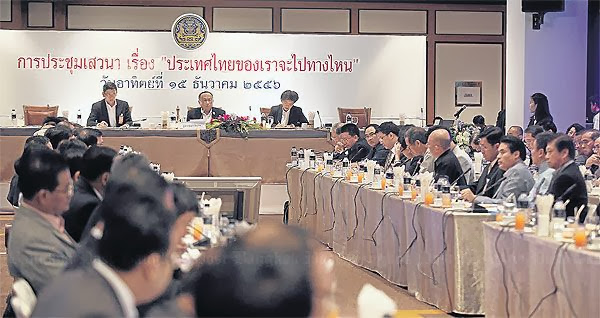
Reds urge Democrats not to boycott contest

Most participants at the government's reform forum yesterday agreed the Feb 2 election should go ahead, while others argued the poll should be postponed to prevent further conflicts.

Representatives from state agencies, political parties, civil groups and the private sector discuss solutions to the political impasse at the government’s national reform forum held yesterday at the Queen Sirikit Convention Centre. PATTANAPONG HIRUNARD
The participants included former MPs, senators, academics, representatives from political parties, the red-shirt United Front for Democracy against Dictatorship (UDD) and the private sector.

However, the anti-government People's Democratic Reform Committee (PDRC) and the Democrat Party did not send representatives to the meeting.

Most participants, including representatives from the Defence Ministry, the UDD, the Pheu Thai Party and some academics, said the Feb 2 election should go ahead on condition that measures be put in place to ensure the vote is clean.

They called on the Democrat Party not to boycott the election as this would only worsen the situation.

However, some participants including Bhumjaithai Party representatives and some academics believed the poll would not help end the conflict and should be delayed until the atmosphere is right.

Speaking after the seven-hour forum, caretaker PM's Office permanent secretary Tongthong Chadransu, who acted as moderator, said the participants had agreed that reform plans must be implemented to address political and economic problems and corruption, and to support power decentralisation and reduce social injustices.
However, the forum still could not reach a conclusion on how to implement the reform, Mr Tongthong said.

Weerapat Pariyawong, an independent legal academic, said the election should go ahead but all political parties must agree that if they win and form the government, they will not serve out a full four-year term and will instead dissolve the House of Representatives within two years to allow national reform to proceed.

Mr Weerapat said election campaigning should focus on national reform rather than populist policies.
UDD leaders Tida Tawornseth and Jatuporn Promphan also supported the Feb 2 poll.

The Defence Ministry's permanent secretary Nipat Thonglek told the forum the armed forces stood by the constitution and the military supports an election on Feb 2.

But PDRC leader Suthep Thaugsuban, speaking on the Democracy Monument rally stage last night, accused Gen Nipat of "distorting" the army's stance.

Mr Suthep claimed the armed forces commanders, whom he met on Saturday, actually did not take any side on the Feb 2 election.

"Gen Niphat's behaviour does not surprise me because he is [former premier] Thaksin Shinawatra's man. Thaksin picked this guy for the defence permanent-secretary post himself," he said.

Mr Suthep said he would call another mass rally in Bangkok soon. He also insisted the Feb 2 election will not happen. "Or if it happens, it won't be a smooth one," he said.

Chaturon Chaisaeng, who represented the Pheu Thai Party, told the forum that before the poll takes place, all political parties should ratify a pact that the next government would step down as soon as it completed laying out the foundations for national reform. This means the next government would not complete a four-year term, he said.
Some participants said they believed an election would not solve the crisis.

Ratchaburi senator Kecha Saksomboon said the election should be postponed to allow the reform process to begin.

He also said the government should step down from its caretaker role to show it is sincere in implementing reforms.

Bhumjaithai Party deputy leader Sohpon Zarum said that while the party agreed with the election, it wants all sides involved in the conflict to work out a new set of rules before the poll is held.
He said politicians are the source of conflict and need to be reformed.

Songsak Thongsri, also from the Bhumjaithai Party, said that since the PDRC insisted it opposed the Feb 2 poll, further conflict will result if it goes ahead.

"We support the election and our party is ready for the election, but it must be held in the right atmosphere," he said.

Gothom Arya, of Mahidol University's Institute of Human Rights and Peace Studies, urged the Democrats not to boycott the vote as it would only make the problem more complicated.

Meanwhile, PDRC spokesman Akanat Promphan yesterday labelled the government's forum a "stunt".

PDRC member Suriyasai Katasila said the forum was full of government supporters and it was organised to distract attention from the PDRC's reform push.

Source: Bangkokpost
South Korean President Park Geun-Hye meets government officials. Photo: 16 December 2013
Park Geun-Hye's comments came at a meeting with senior government officials
South Korea's president has warned of possible "reckless provocations" by the North, following the shock execution of leader Kim Jong-un's uncle.

President Park Geun-Hye said the South Korean military must step up vigilance along the border with the North.

She said last week's execution of the influential figure Chang Song-thaek left the region in a "grave and unpredictable" situation.

Mr Chang was executed after allegedly planning a coup.

The move - together with the recall of a North Korean business team from China - prompted concerns that Mr Chang's associates were being purged as part of a campaign by Kim Jong-un to consolidate his power.

It also led to fears for the stability of the nuclear-armed state.
 
'Business as usual'

"Given the latest development in the North, it is uncertain in what direction its political situation would evolve," President Park said during a meeting with senior government officials on Monday.

"We also can't rule out the possibility of contingencies such as reckless provocations," she added.

Ms Park is due to meet top level security officials later on Monday to discuss the situation.

Meanwhile, North Korea has been keen to present an image of business as usual, the BBC's Lucy Williamson in Seoul reports.

A government official in Pyongyang said on Sunday that the country's economic plans would carry on undisrupted.

At the same time, Mr Kim has continued with his usual public appearances, visiting a military design institute and a construction site.

Mr Chang had been building trade with China before his removal led to speculation that a drive to attract foreign cash would end.

His execution has sparked fears of military action by Pyongyang as a way to build unity in the country, our correspondent adds. 

Source: phnompenhpost
Chinese policemen on patrol in this file photo taken in Kashgar, a city in China's volatile western region of Xinjiang.

Beijing -- Sixteen people have been killed in violence in China's volatile western region of Xinjiang, state media reported Monday.

Two police officers chasing suspects came under attack late Sunday from people with machetes and explosive devices in Shufu county, near the city of Kashgar, said Tianshan, a news website run by the Xinjiang government.

In the clash that ensued, two police officers died and 14 "gang members" were shot and killed, Tianshan reported. It described what happened as a "terrorist attack."

Police detained two suspects, the report said, and the violence is under further investigation.
Deadly unrest frequently breaks out in Xinjiang, a large, resource-rich region that is home to the Uyghurs, a Turkic-speaking, predominantly Muslim ethnic group.

The arrival of waves of Han Chinese people over the decades has fueled tensions with the Uyghurs. Chinese authorities have cracked down heavily on violence involving Uyghurs, deepening resentment.

The Tianshan report Monday didn't specify the ethnicity of the people involved in the clash with police.

The details of violent clashes in Xinjiang often remain murky. Uyghur diaspora groups, like the World Uyghur Congress, have criticized the Chinese government for the lack of transparency over such events.

Xinjiang government officials didn't immediately return calls from CNN seeking further information on Sunday's violence.

Chinese authorities have blamed Uyghurs for a vehicle attack in Beijing's Tiananmen Square in October that killed five people -- including the three in the vehicle -- and wounded 40 others.

Xinjiang's worst violence in decades took place in July 2009, when rioting in the capital, Urumqi, between Uyghurs and Han Chinese killed some 200 people and injured 1,700. That unrest was followed by a crackdown by security forces.

Xinjiang is now home to more than 8 million Han Chinese, up from 220,000 in 1949, and 10 million Uyghurs. The newcomers take most of the new jobs, and unemployment among Uyghurs is high.

They complain of discrimination and harsh treatment by security forces, despite official promises of equal rights and ethnic harmony.

Beijing accuses some Uyghur groups of trying to establish an independent state.

Source: CNN
A highway patrol officer collects passengers' belongings from the bus that fell from an elevated highway in Manila.

At least 15 people died when a bus plunged off an elevated freeway in the Philippine capital Manila early Monday and landed on a van, the country's official news agency reported.

The accident happened on the Skyway in the Manila suburb of Paranaque City. In addition to the deaths, at least seven bus passengers were hospitalized, police told the Philippines News Agency.

The accident happened around 5:15 a.m. (4:15 p.m. Sunday ET), the agency reported. The cause was still under investigation, the agency quoted Skyway official Luis Panganiban as saying.

Source: CNN
Syrians help a wounded woman following airstrikes on a rebel area in Aleppo on December 15.
At least 83 people died in aerial bombardments conducted by government forces in Aleppo, Syria, Sunday, said the Local Coordination Committees, an opposition group. At least 50 more people sustained injuries.

Helicopters dropped barrel bombs on 12 neighborhoods in the city, where people have strongly backed rebels opposing the government of President Bashar al-Assad.

The LCC said 135 people died in total in the conflict on Sunday.

The United Nations estimates that more than 100,000 people overall have died since the Syrian conflict began in March 2011. Hundreds of thousands of civilians have also been injured.

In addition, more than 2.3 million people have fled Syria, and another 4.25 million Syrians have become refugees within their country since the civil war began, according to an Amnesty International report released on Friday.

 Source: CNN

Sunday, December 15, 2013

At least 16 people were killed in shootings and explosions across the Iraqi capital of Baghdad on Saturday, police said.

In one attack, roadside bombs went off in an outdoor market. In another, a car bomb exploded in a Shiite procession commemorating the death of an imam.

Along with the deaths, at least 36 people were wounded.

Iraq has been beset by Sunni-Shiite sectarian violence and political strife this year. More than 8,000 people were killed in acts of violence across the country over the year, according to U.N. figures.

Source: CNN

Thousands took to the streets of Madrid Saturday to protest against a proposed law that would, among other things, impose stiff fines on illegal demonstrations, according to state-run broadcaster TVE.

Much of the protest was peaceful, but a small group clashed with riot police and seven people were arrested. Officials said at least 23 people were injured, including 14 police officers.

"The voice of the people is not illegal," protesters shouted as they were met by 1,250 riot police, TVE reported.

Under the proposed law, unauthorized demonstrations in front of the Parliament building carry a fine of up to 30,000 euros (about $41,000), but the measure is likely to pass as conservatives hold the majority in the government.

Spain has seen its share of protests since the government imposed austerity measures to comply with European Union demands. Spain's unemployment is at 26%, one of the highest jobless rates in Europe

Source: CNN
A Chinese military plane H-6 bomber flies through airspace between Okinawa prefecture's main island and the smaller Miyako island in southern Japan, out over the Pacific, in handout photo taken 27 October 2013 by Japan Air Self-Defence Force and released by the Joint Staff Office of the defence ministry of Japan
China's unilateral declaration of an air defence zone over the East China Sea - which includes disputed islands - has made its neighbours' hackles rise
Japan and SE Asian leaders have pledged to work together to ensure "freedom of overflight" in the region, in a move seen as a mild rebuke to China.

The announcement came at a summit in Tokyo, weeks after China's declaration of a new air defence zone overlapping areas claimed by Japan and South Korea.

Japan has been rallying support from 10 Asean nations, some of whom also have territorial disputes with China.

Earlier, PM Shinzo Abe unveiled a $20bn (£12bn) package of aid and loans.

It is part of Japan's apparent efforts to court its southern neighbours against a backdrop of Chinese expansion in the region.

The Tokyo summit marks 40 years of Japan's ties with the Association of South East Asian Nations (Asean).

Indonesia said good China-Japan ties were "critical" for the region.
 
'Unimpeded commerce'

Japanese and Asean leaders "agreed to enhance co-operation in ensuring freedom of overflight and civil aviation safety", said a passage in their statement quoted by AFP news agency.

The statement does not single out any particular country but is thought to be an allusion to the air defence zone above the East China Sea - the Air Defence Identification Zone (ADIZ) - unilaterally declared by China last month.

China had said that aircraft flying through the ADIZ - which covers an area containing disputed islands not controlled by China - must follow its rules, including filing flight plans and identifying themselves.

But it insists the ADIZ is not a no-flight zone.

The statement also refers "to the importance of maintaining peace, stability and prosperity in the region and promoting maritime security and safety, freedom of navigation, unimpeded commerce, exercise of self-restraint and resolution of disputes by peaceful means".

Japanese Prime Minister Shinzo Abe makes a speech in Tokyo, 13 December 2013
Commentators say Japan is trying to court its southern neighbours in an apparent bid to counter China's growing economic and military might
Mr Abe's financial package will be spread over five years, and will mostly take the form of concessional loans.

It will focus on development in the Mekong river region, which stretches from China in the north down through south-east Asia, and fund transport projects.

He said he wanted to build a future of Asia "where laws, rather than power, rule".

Indonesian President Susilo Bambang Yudhoyono said good relations between China and Japan were "critical to the future" of the region.

"Indonesia is deeply concerned at the prospect of the disputes erupting into open conflicts, which will have adverse impacts on all countries in the region," he said.

The Philippines, which is involved in an ongoing row with China over islands in the South China Sea, said it was committed to freedom of flight in international airspace without specifically mentioning China.
 
Zone defied

Chinese Foreign Ministry spokesman Hong Lei, asked about the summit on Thursday, said the relevant countries should work to maintain regional stability.

The countries "in developing their relations, should not target third parties or hurt third-party interests", he said.

Military aircraft from the US, Japan and South Korea have defied the ADIZ, flying unannounced through the area.

Washington has called China's declaration of an ADIZ a bid to unilaterally change the status quo in the region. There are fears a similar zone will be declared above the resource-rich South China Sea, which China largely claims as its own.

Asean groups Brunei, Cambodia, Indonesia, Laos, Malaysia, Myanmar (Burma), the Philippines, Singapore, Thailand and Vietnam.

Map of east china sea and declared air defence zone

 Source: BBC News
Kim Jong-un (North Korean leader) – centre, black coat; Hwang Pyong-so (Vice-departmental director of Party Central Committee) - far left, civilian clothes; Choe Ryong-hae, (Vice-marshal of the armed forces) - third from left, holding little green book; Jang Jong-nam (New defence minister) - 4th from left, holding big notes
Kim Jong-un has been shown in a series of images released by North Korean state media touring a military institute surrounded by loyal military officers, in an apparent show of his grip on power
North Korean business people are being recalled from China following the execution of top official, Chang Song-thaek, says a South Korean report.

Leader Kim Jong-un may be purging associates of Mr Chang, who was in charge of economic ties with China.

Mr Kim has been pictured by state media for the first time since the execution of Mr Chang, his uncle.

The South Korean government believes Kim Jong-un is trying to consolidate his power through a reign of terror.

The execution of the leader's uncle on Friday raised international concern about the stability of the nuclear-armed state.

North Korea has summoned back business people working out of the north-eastern Chinese cities of Shenyang and Dandong, sources told the South Korean news agency Yonhap.

They are in China to enhance bilateral trade and investment.

Another source told the agency Pyongyang planned to bring all officials and staff home from China in stages.

It appeared to be a crackdown on those perceived as loyal to Mr Chang, Yonhap said.

It could also be another sign that Mr Chang's downfall reflected discomfort at his enthusiasm for Chinese-style economic reform.

There have been other reports over recent days about officials being recalled to North Korea from abroad.

South Korean intelligence officials say two of Mr Chang's closest aides were executed last month, and analysts suggest the purging of such a high-profile figure is unlikely to take place without a "ripple effect" - a purge of others linked to them.

Mr Kim was pictured in photographs released by state media for the first time since the dramatic execution of Mr Chang on Thursday following a military trial.

He was shown touring a military design institute, trailed by military officers, many taking notes. Among them was Mr Kim's personal envoy, Vice-Marshal Choe Ryong-hae.

This undated picture released by North Korea's official Korean Central News Agency (KCNA) on 14 December 2013 shows North Korean leader Kim Jong-Un (C) inspecting a military design institute at an undisclosed location in North Korea
Mr Kim is shown dispensing guidance for his followers, in the manner customary to the ruling Kim dynasty.
This undated picture released by North Korea's official Korean Central News Agency (KCNA) on 14 December 2013 shows North Korean leader Kim Jong-Un (C) inspecting a military design institute at an undisclosed location in North Korea
Among them is his personal envoy Vice-Marshal Choe Ryong-hae, second from left - apparently still firmly in favour.
This undated picture released by North Korea's official Korean Central News Agency (KCNA) on 14 December 2013 shows North Korean leader Kim Jong-Un (C) inspecting a military design institute at an undisclosed location in North Korea
There is speculation Mr Kim is conducting a purge of those advocating a different economic policy.
The pictures appeared designed to demonstrate Mr Kim's continuing hold on power and "business as usual" for the North Korean leadership, said commentators.

The images will also be scrutinised for clues to Mr Kim's inner circle, analysts say.

Among those pictured in the latest photographs are believed Hwang Pyong-so, vice departmental director of Party Central Committee (not in military uniform), Choe Ryong-hae, vice-marshal of the armed forces, and Jang Jong-nam, the nation's new defence minister.

Mr Chang was married to the sister of late leader Kim Jong-il, and is believed to have mentored Kim Jong-un when he succeeded his father in North Korea in 2011.

He had been seen as the second-most important figure in the country, holding several key posts, but last week was shown being dramatically removed from a special party session by armed guards and stripped of all his titles before his execution days later.

Source: BBC News


A Japanese diplomat has been wounded in a reported failed kidnap attempt by armed men in Yemen.

The second secretary at the embassy was stabbed five times by unknown men in an attack which took place in the Yemeni capital Sanaa, the embassy said.

The diplomat was resisting a kidnap attempt in front of his house, Reuters reported. But another report said attackers struck the envoy in his car.

Attacks on foreigners in Yemen have intensified in the past few months.

Yemen has been plagued by instability since its longtime president, Ali Abdullah Saleh, handed over power after a popular uprising in 2011.

MAP

 Source: BBC News
Wreckage of the minivan targeted in a grenade attack in Nairobi, Kenya.
At least five people have been killed in the grenade attack on a minibus in the Kenyan capital of Nairobi, the country's Interior Ministry said Saturday on its official Twitter account.

An attacker was among those killed. Other people were injured in the strike, strongly condemned by the ministry.

The blast occurred in the predominantly Somali neighborhood of Pangani.

The grenade tore through the bus, blew out windows and sent debris flying into the busy street. Security forces were sifting through the wreckage for clues on who might be responsible.

The attack is the deadliest in Nairobi since the September siege of an upscale mall by the Somali terror group Al-Shabaab, an affiliate of al Qaeda, where 67 people were killed.

Source: CNN

Arena do Amazonas, Manaus
The stadium will host England's opening match of the 2014 World Cup
A worker has been killed in Brazil after falling from the roof of a stadium being built in the Amazon region for the 2014 football World Cup.

Marcleudo de Melo Ferreira, 22, died in hospital in Manaus after falling nearly 35m (115ft).

Hours later, another worker died of a heart attack at a nearby site. His family said he was overworked.
The builders' union is discussing whether to strike over working conditions.

Several construction workers have now died at venues connected with the World Cup as Brazil rushes to complete its stadiums on schedule.

Two were killed in an accident on 27 November when a crane fell and destroyed parts of Sao Paulo's Arena Corinthians, which will host the opening game on 12 June.

That accident delayed the stadium's completion date by several months. It is now expected to be ready in mid-April.
'Sunday to Sunday'
 
Andrade Gutierrez, the company building the Manaus stadium, said Mr Ferreira had been employed by a company subcontracted to construct the stadium's cover.

It said work had been halted until Sunday.
But the death of a second worker, at a convention centre building site, led to new calls by the union to begin a strike from Monday.

The body of Jose Antonio da Silva Nascimento, 49, was found late on Saturday morning at the new building, which will host meetings during the World Cup.

His death may not be connected with the working conditions, but relatives said he was under pressure because the work was behind schedule.

"He worked from Sunday to Sunday," sister-in-law Priscila Soares told O Globo newspaper.
The stadium in the Amazonian jungle city is where the England team will open their 2014 World Cup campaign, playing against Italy.

Protest sign at Maracana stadium in Rio, Brazil (6 Dec 2013)
Brazil has faced protests over the cost of hosting the tournament
 
Brazil has admitted it is struggling to have all 12 venues completed on time. Six venues are ready; the other six have missed this month's deadline set by Fifa - the world's football governing body.

The country's preparations for the World Cup have also been hit by cost overruns and public protests over what is seen as wasted resources.

Last week Fifa's General Secretary Jerome Valcke appealed to Brazilians to support the contest saying it was the "wrong time" to protest.

More on This Story

Related Stories

Pro-EU protesters guard a barricade near the Independence Square in Kiev. Photo: 15 December 2013
Pro-EU protesters have been guarding barricades around their main camp in Kiev

Supporters and opponents of Ukrainian President Viktor Yanukovych are to hold rival protests in Kiev, amid fears of possible clashes. 

Activists and opposition parties are hoping hundreds of thousands of people will take part in a "Dignity Day" rally in the central Independence Square.

Mr Yanukovych's backers will gather in the nearby Mariinskyi Park.
Protests began last month after the president's last-minute move to pull out of a landmark deal with the EU.

Mr Yanukovych has said he fears the association and trade agreement will put at risk many enterprises dependent on trade with Russia.

The president - who says he eventually aims to sign the deal - has also admitted being under heavy pressure from Moscow, which wants Kiev to join a Russian-led customs union instead.
'Provocateur' fears
Several thousands pro-EU protesters remained overnight in Independence Square ahead of their rally, which is expected to start at 12:00 local time (10:00 GMT) on Sunday.
 
BBC's David Stern: This is the first time these two groups have faced-off in the capital

Barricades around the perimeter of the main protest encampment in the heart of the capital have been strengthened following an attempt by special police to dismantle them earlier this week.

Opposition leaders have urged protesters to remain vigilant, fearing "provocateurs" could trigger clashes between rival demonstrators.

The opposition has also accused the authorities of bussing people into Kiev for the pro-government rally and providing them with money and food. 

The authorities officially deny this, but a number of participants in the rally have said they were forced to take part.

The two rival camps held demonstrations close to each other on Saturday. There were no reports of any clashes. 

Supporters of Yanukovych's party of Regions hold portraits of Ukrainian President Viktor Yanukovych as they gather for their rally (14 Dec 2013) Yanukovych supporters rallied near the pro-EU barricades on Saturday
 
Pro-European Union activists cook food during a rally in Independence Square in Kiev, Ukraine (Dec. 14, 2013)

In a separate development, Mr Yanukovych suspended his deputy security chief and Kiev's mayor over the police violence against pro EU-protesters on 30 November. 

Prosecutors are investigating Volodymyr Syvkovych and Olexander Popov - alongside another two senior officials - on suspicion of abuse of office in the crackdown. 

This has energised the pro-EU protesters, who are demanding that all those involved in the clampdown be sacked and punished. They also want the government to resign.

System 'reload'
While pro-EU protests have gripped the capital and other cities in western and central Ukraine, President Yanukovych retains support in the east and south. 

However, that backing may be dwindling, correspondents say, and there have already been pro-EU rallies in the south-east.
Protesters say Mr Yanukovych's U-turn on the EU deal triggered the mass demonstration, but they now want the total "reload" of what they describe as a corrupt system of governance.

They believe signing the EU deal would root out corruption and make Ukraine's economy more open and transparent, citing as an example Ukraine's neighbours to the west who are now EU members.

However, the government and its supporters fear that economic liberalisation would hurt the country's economy, especially the industrial south-east which relies on trade with Russia. 

Moscow has already put economic pressure on Ukraine, with customs delays and a ban on Ukrainian chocolates, and there are concerns it could escalate such measures if Kiev drew closer to Brussels.


Map of Kiev


Source: BBC NEWS 


other stories:

Blogger Tips and TricksLatest Tips And TricksBlogger Tricks